
Why mess makes us snap… and how to stay calm
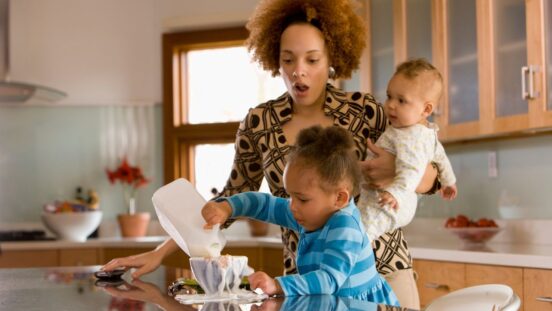
“It’s not the mess”: Parenting expert Dr Justin Coulson on what’s really behind parenting stress.
Ever wondered why something as small as spilled milk is enough to send your stress levels soaring?
According to parenting expert Dr Justin Coulson, those messy, chaotic moments don’t just test our patience, they tap into something much deeper.
As a dad of six daughters, grandfather, co-host of television show, Parental Guidance and voice behind The Happy Families podcast, Justin has seen firsthand how quickly everyday mess can trigger big emotional reactions. The good news is a simple shift in mindset can change everything.
When mess = meltdown. Dr Justin Coulson on breaking the stress cycle
Why do messy moments often trigger such a strong stress response in parents? Is it biological, psychological, or both?
Both! For many of us, we’ve been taught to see disorder as a potential problem or threat. And biologically, this creates high anxiety. The reality is that a toddler with a bowl of spaghetti starts to feel very stressful for a lot of parents. Once we layer on top of that a fear of judgement (“what kind of parent lets this happen?”) and a need for control (which parents in 2026 have in abundance), we find ourselves having a full-blown stress response over spilled yoghurt.
Beyond that, having kids is tiring. And messy. It feels like we go from one messy catastrophe to another with no break. And our child doesn’t notice the mess (or how hard we’re working to tidy it up). Our expectations that we’ll have the “Instagramable” home and playtime/food time with our baby or toddler is the real issue. At the risk of sounding a little pessimistic, the secret to happiness is… low expectations. Ha!
Many parents link mess with a loss of control. How can we reframe this perspective, so it feels less overwhelming?
Here’s the reframe: mess isn’t a loss of control. It’s evidence of a developmentally appropriate toddler life being lived. The research on control and wellbeing is clear: in 2008 van der Bruggen and colleagues found that the more we try to control everything, the more anxious we become – and the more anxious our kids become. That’s a terrifying prospect. Our kids catch our anxiety (or our perfectionism), and it’s all correlating with our need to control things.
Letting go of the idea that a tidy house equals good parenting is almost impossible for some of us, but if you can get there, it’s genuinely liberating. Control the important stuff. Let the rest be messy. A while back I came across a quote that’s stuck with me. “You cannot overestimate the unimportance of practically everything.” The mess is massively unimportant. Stop making it matter so much.
How does a parent’s reaction to mess impact a child’s emotional development and resilience?
Emotions are contagious. Whatever you’re conveying, your kids will catch. They’re emotional sponges. They literally absorb our emotions. So when a parent catastrophises over a mess, kids learn that mistakes and disorder are dangerous. It pumps up their anxiety. It increases their perfectionism. It teaches them that their worth is tied to whatever this thing is we’re reacting to so much.
But when a parent shrugs and says “no big deal, let’s sort it,” they’re teaching something far more valuable than tidiness: they’re teaching resilience. Our calm is contagious. Our cranky is contagious. Our chaos is contagious. So is our calm.

Can you share practical ways parents can reframe mess as something positive, like a learning opportunity, a moment of creativity, or family bonding?
I’m not going to pretend that mess is positive. I like things clean and tidy just like the next clean-freak parent. Mess drives me bananas. But context is everything. If I know I can clean it up, put it away, wipe it down, and have my space back, I can deal with the mess in the moment.
But if you are going to get messy (or you find a mess), a useful reframe is to ask better questions. Instead of “who did this?!” try “what were you making?” Instead of cleaning up immediately, pause and get curious, not furious. Understand, don’t reprimand. Maybe even get stuck in and get your hands dirty. It’s surprisingly regenerative once you start. Mess is often just creativity without awareness (which is developmentally standard for young kids – and even some grown ups).
With six kids, I’ve often found that cleaning up together – with some music and silliness – can become one of those surprisingly warm family moments nobody plans but everyone enjoys. And you get to teach your child some responsibility. A new favourite in our house is The Wipe Up Dance, a new clean-up anthem released by WaterWipes in collaboration with leading cognitive neuroscientist, Dr Bradley Vines and award-winning global music lab Squeak E. Clean. The song is designed to reduce the stress during clean-ups by injecting joy and capturing children’s attention – turning life’s messes into melodies.
Are there small mindset shifts or daily habits parents can practice to reduce stress when things get chaotic at home?
So many. Here are a couple of ideas:
- Lower the bar – on purpose. Decide in advance that some mess is acceptable today, and you’ve already won half the battle.
- Try a “good enough” mantra for the non-negotiables.
- Remind yourself that this is exactly what your kids need (even if it’s not quite exactly what you need).
- And build in a five-minute reset at the end of the day rather than trying to maintain impossible standards throughout it. If you’ve got lots of kids or a big mess, make it a “ten-minute-tidy”.
- In our home we do “all in” which means we’re all going to get stuck in and contribute.. I recommend putting on some music. WaterWipes has actually come up with a scientifically backed clean-up anthem: The Wipe Up Dance to capture the attention of your little ones, while fostering joy and connection.
Progress, not perfection.
How can parents carry the mindset of reframing into other stressful parenting situations, like tantrums, sibling fights, or hectic mornings?
The same question works everywhere: “Is this a problem to solve, or a moment to connect?”
Your kids aren’t the problem. They’re having one. They don’t have the tools to manage the demands of the moment.
Slow it down. Soften your eyes. Say what you see (“this is tough, isn’t it?”). Offer a hug or some space. When they’re calm, problem-solve together.
We get so focused on fixing everything here and now – and it’s unproductive and unhelpful. Instead, focus on balancing emotions, and then solving problems (where your child has a voice).
Most chaotic parenting moments are actually bids for connection in disguise. When we stop trying to fix everything, everything gets a little less overwhelming.