Toy Story 5 has a message for every parent, and it’s not about the toys
I watched Toy Story 5 as a play therapist. I wasn’t expecting it to say this to parents.
By Dr Kate Renshaw, founder and director of Play and Filial Therapy
As we queued for tickets, I noticed a five-year-old boy next to me waiting for his parents to pay. In one hand he clutched a Buzz Lightyear doll. In the other, a Woody. He stood next to an older brother, maybe 13 or 14, who had clearly grown up on the Toy Story films and was back for number five. As they moved off toward the theatre, a younger sister stepped forward clutching a Jessie doll.
I’m not sure I’ve ever been more hopeful that “old school” toys would still be beloved companions to young children after a film.
I went to see Toy Story 5 as a play therapist, researcher, and mother. I came home thinking Pixar had made the most quietly radical film about childhood, screens, and play in years. It is funny and warm and visually gorgeous. It is also, if you know what to look for, making a serious argument. And that argument is aimed gently at parents.
The film has a message, and it’s about our children
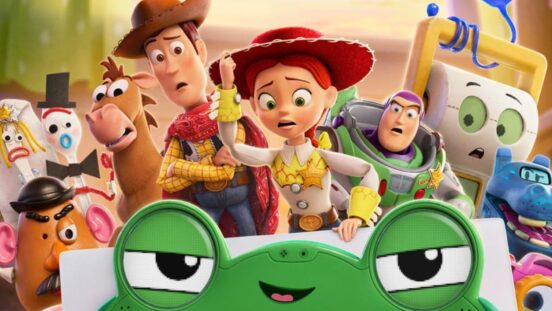
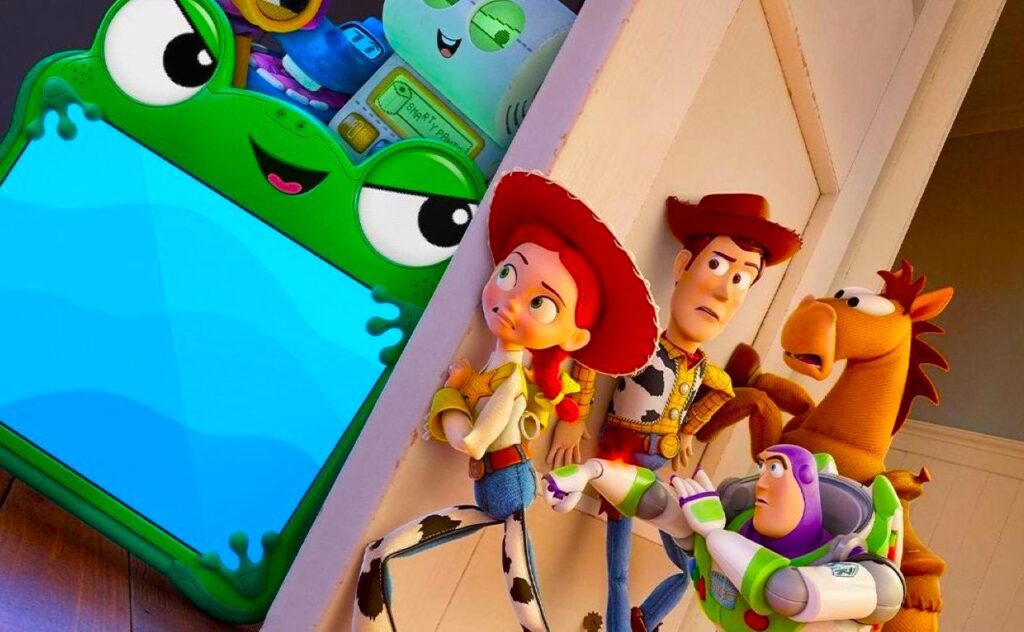
The villain of Toy Story 5 is not a person. It is a device: LilyPad, an AI companion given to Bonnie by her well-meaning parents along with the instruction to “explore it today, then we’ll talk about screen time.” Lily, as she becomes known, is sleek, helpful, and “always listening.” She can send a friend request to a dance class group chat. She can optimise Bonnie’s social life from a distance.
What she cannot do is help Bonnie make a real friend.
Jessie puts it plainly to Lily mid-film: “Our kid needs to learn how to make friends, and you’re not helping.” When Bonnie asks, bewildered, “Mum, Dad, why can’t anyone be my friend?”, the film doesn’t let us parents off the hook. Dad is on a Zoom call. Mum is quietly busy. The LilyPad fills the gap. The toys, watching from the sidelines, understand what the adults have missed: Bonnie needs to be in the world, with other children, doing the messy, uncertain, glorious work of real play.
What Jessie almost got right
One of the sharpest moments in the film comes when Lily defends herself by pointing out that Bonnie is playing games on her screen. Jessie’s response is unambiguous: “That’s not play. That’s just a game.” It’s a memorable line, though as a play therapist I’d offer more nuance. Game play, including well-designed tech games, can absolutely be play. What Jessie is really pointing at is something more specific: the difference between passive consumption and active, co-created, embodied play with another person.
The film is highlighting the difference between passive, not always playful, screen time and active, embodied, imaginative play. Real pretend play is generative: children invent the problem, negotiate the rules, regulate their emotions in real time, and feel the full aliveness of being genuinely present with another person. No device replicates that. Not yet. Not ever, I would argue, because the magic is not in the content. It is in the relational co-creation.
The best players in the film have four legs
Here is what surprised me most: the film’s most memorable moments of genuine connection involve animals. Daffodil, Blaze’s horse who Jessie befriends, recognises Jessie with what the film beautifully renders as eye flares, an unmistakable flicker of recognition and warmth. Jimmy Dean, Blaze’s pig, and Sammy, Bonnie’s salamander, join the play without hesitation, without instruction, without a prompt.
But it is the mammals, Daffodil and Jimmy Dean, who bring something more: sentient beings with empathy, they read the emotional state of the other players and respond to it, not because they are programmed to, but because they feel it.
This is the contrast the film is quietly drawing, and it is a profound one. Lily listens. Lily retrieves. Lily optimises. But Lily does not feel Bonnie’s loneliness. Lily does not notice that something is wrong and lean in. The animals do. Her parents do. Even her new friend Blaze does.
In play therapy we understand toys as part of playful expression, the language of children. A real toy in real hands is a medium through which children communicate what they cannot yet put into words, to their friends, to their family, to the adults who matter to them.
For children, who are highly attuned social mammals themselves, this distinction matters. They feel the difference between being responded to through technology and being truly experienced by another. One nourishes them. The other, over time, leaves them more developmentally vulnerable.
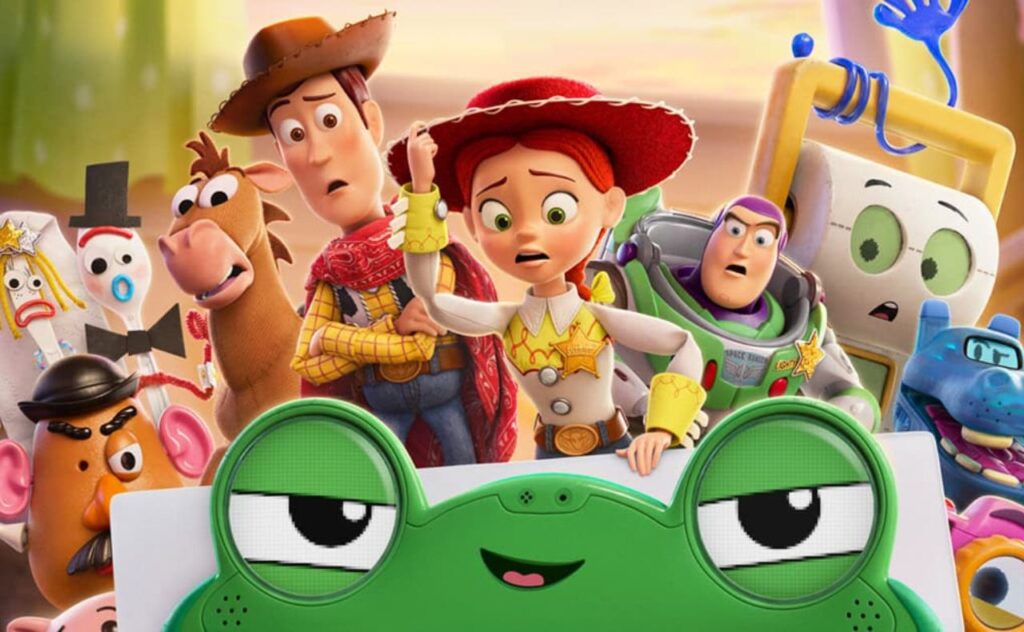
Toy Story 5 has a message for parents, and it’s honest about it
Toy Story 5 is gentle with parents, but it does ask them to pay close attention. The LilyPad is not given out of neglect. It is given out of love, and busyness, and the reasonable hope that technology might help. The film seems to understand that most of us are trying our best to integrate technology into our lives, without always understanding the developmental implications. But the film asks us to consider children’s developmental needs and in what ways technology can truly support them.
What real friendship requires
The film’s treatment of Bonnie and Blaze’s relationship is its emotional heart. Blaze is lonely in a different way: socially capable but out of town and isolated. When Bonnie and Blaze finally play together, really play, it is tentative at first and then suddenly completely immersive. They fall into it. The old tech toys, watching, cannot believe what they are witnessing. One toy says, “That was so fun.” Another: “That was so beautiful.” A third: “I feel so alive.”
What unlocks it is not a programme or a prompt. It is Jessie saying, simply: “Let’s play.” And then getting out of the way.
That is the most practical thing the film offers parents: the reminder that children do not need us to engineer their friendships. They need us to create the conditions, the time, the space, the permission to be playful, and then to trust them to find their own connections.
What to do with all of this
As the credits rolled, the audience clapped. Real clapping, at the end of a children’s film, in 2026. I think they were clapping for something more than the movie. I think they were clapping because the film said something true, and said it with warmth rather than judgment, and it left everyone in the room feeling quietly hopeful about what children are capable of when we give them the chance.
The LilyPad in your house might not be an AI. It might be a screen, another type of technology, a group chat, or a well-intentioned shortcut. The question the film is really asking is: what are we substituting for real relational play? Is our child getting enough of the real thing? And are we helping our children use technology to play and connect in a balanced way?
Real play is embodied. It is relational. It is uncertain and sometimes uncomfortable and occasionally glorious. It involves other sentient beings, human or animal, who bring themselves fully to the encounter. It cannot be outsourced. This doesn’t mean technology has no place. Used well, it can bridge children toward each other, helping them arrange a playdate, game online together, stay connected with a friend who has moved away, or share something they love. The question is whether it is bringing them closer to real connection, or substituting for it.
And it is, the film argues beautifully, what children are made for.
Go and see it. Take the kids. And on the way home, leave the phones in your pockets.
Dr Kate Renshaw is a Registered Play Therapist-Supervisor, researcher, author, and the founder and director of Play and Filial Therapy. She works as a play therapist in schools and lectures internationally in play therapy. She is the author of Hello Elephant Mumma! Find her at drplay.com.au