If you’re questioning whether you’re getting it right with your son, read this

What parenting expert Dr Justin Coulson knows about raising boys that many of us don’t.
If you’ve ever tried to coax a one-word answer out of your son about his day, or quietly wondered whether you’re doing enough – whether you’re saying the right things, modelling the right things, or just keeping up with what he’s seeing online – you’re not alone. And according to Dr Justin Coulson, Australia’s most trusted parenting expert and father of six, you’re already doing better than you think.
Because the parents asking the hard questions? They’re the ones who love their kids most deeply. And that, he says, is exactly where good parenting begins.
Dr Justin Coulson sat down with Bounty Parents has spent more than two decades researching what boys really need. Here’s what he shared with us.
Boys don’t need a list of don’ts. Here’s what healthy masculinity actually looks like
The parents asking hard questions about their sons are doing so because they love them deeply and that’s exactly what we need more of.
What I really want to talk about is what healthy masculinity actually looks like, because I think that’s the more useful conversation. We’ve spent a lot of time telling boys what not to be. Don’t be aggressive. Don’t be dominant. But you can’t build a young man on a list of don’ts. Boys need something to run toward, not just things to run away from.
And here’s what I’ve landed on after twenty-plus years of research and four years writing this book: a healthy man is one who helps the people around him feel safer and stronger. He shows up as a bonus. He gives more than he takes. He builds people up rather than tearing them down.
When that becomes the north star (for parents, for schools, for coaches, for anyone raising or working with boys) everything else starts to make sense. The conversations get easier. It’s giving him a positive vision of something to work towards. He’s becoming someone. When you give boys something worth working towards – something worth becoming – they’ll live up to it more often than not.
Boys aren’t the problem. They’re the solution.
I’m not so worried about boys as I am about the criticism and judgment they’re receiving. While some rightly need some correction and direction, we’ve got to stop looking at boys as the problem becasue they’re not.
They’re the solution! They need fewer critics and judges, and they need more models and advocates. (And so do their parents.) Every time we tell a boy that masculinity is toxic, he questions his value.
Every time we tell a girl that masculinity is toxic, she becomes more hateful of boys. It’s a mess. And that is what worries me the most. Our conversation is focused in the wrong direction. We need to be talking about – and showing – what healthy masculinity is.
Why “man up” and “boys will be boys” are both doing damage
Let’s be honest about what “man up” actually means. It means: your feelings are inconvenient and unmanly. Stop having them, push them down, banish them, and instead start to act and look like “a man”. And we’ve been saying that to boys for generations and then wondering why they can’t talk about what’s going on inside, why they don’t seek help, why they suffer in silence until the silence becomes unbearable.
“Boys will be boys” is just as corrosive in a different direction. It doesn’t set a low bar. It removes the bar entirely. It tells a boy his behaviour is biology. That nobody expects better. And once you’ve told him that, you’ve lost him.
When you have to show everyone how strong you are, it suggests you’re not as strong as you think. And when you’re willing to let people know you’re human, that’s when you’re strongest. And I want to encourage parents to let their boys be energetic, use their bodies, and be active. So long as they’re not hurting people or property – so long as the people around them feel safer and stronger with the boys in their presence – they’re doing it right.
The earlier your start talking the better
The younger you start, the better. Talk about what you’re grateful for. Talk about where you saw strength. Or kindness. Or humility. Or grace. And invite your sons to do the same. Show them that it’s braver to talk about hard things than to keep them inside.

When big feelings hit, do this
This is a practice thing. It starts young – around age 3. But kids are terrible at it. It gets better each year until about age 9-10 when most kids can do a decent job most of the time. But the reality is that many adults are still kinda lousy at undersatnding and regulating their feelings.
When someone feels the big feelings, say it out loud, “I can tell this is tough for you right now.” Offer a hug or some space. Once they’re balanced, move to problem-solving. Do it slowly, supportively. Show them you’re in their corner. Discipline is about problem-solving and helping, not hurting. And big emotions work like the waves on the shore – they come in and they go out. With time, the wave recedes and we can solve those big problems.
Connection doesn’t require a special moment
If we can put our phones down and be present, every moment is one of those moments. Driving. Prepping dinner. Bath or bed time. Doing dishes. Hanging washing. Kids are desperate to be in our lives. We just have to take an interest and invite them in. Remember: connection means feeling seen, heard, valued, and accepted. So do that lots and he’ll feel connection.
You can’t outcompete screens, so stop trying
We can’t compete. That’s the horrible reality. The algorithm, the persuasive design of the game, and the excitation and stimulation the screen offers is beyond anything we can offer. So rather than competing on their terms, we need to change it up by offering something the screen can’t: real life joy and experience.
Why positive male role models matter
Dads, whenever research looks for their impact, are vital. They add to wellbeing and learning and character over and above what mums do. Each plays a unique part and each is so powerful in their contribution to a child’s life. A real turning point in a boy’s life is if/when his dad leaves his life. And (even sometimes when Dad isn’t a great influence), it almost always turns to additional challenges for that boy. We’ve got to be sure boys are engaged with good men – men who model what it is to help those around them to feel safer ad stronger.
What boys need most from their mums
Boys almost always have a soft spot in their hearts for their mums. Mum – remember that love is spelled T-I-M-E. Show an interest. Engage. Help him feel seen, heard, valued, and accepted. And remember, he needs good male role models and he needs good limits. It’s a pretty simple formula (that can be hard to live out): Love, Limits, and lots of Laughter.
The three words he needs to hear
This is one of those impossible questions because every boy is going to show it differently. Some will open up. Some will go quiet. Some will get active. Some will retreat to their room. They’re ALL on their screens so that’s not going to be a helpful answer. My best response is this: you know your son. Keep the connection open. Help him know you love him no matter what. Those three words are vital. Not, I love you. But the next three: no matter what.
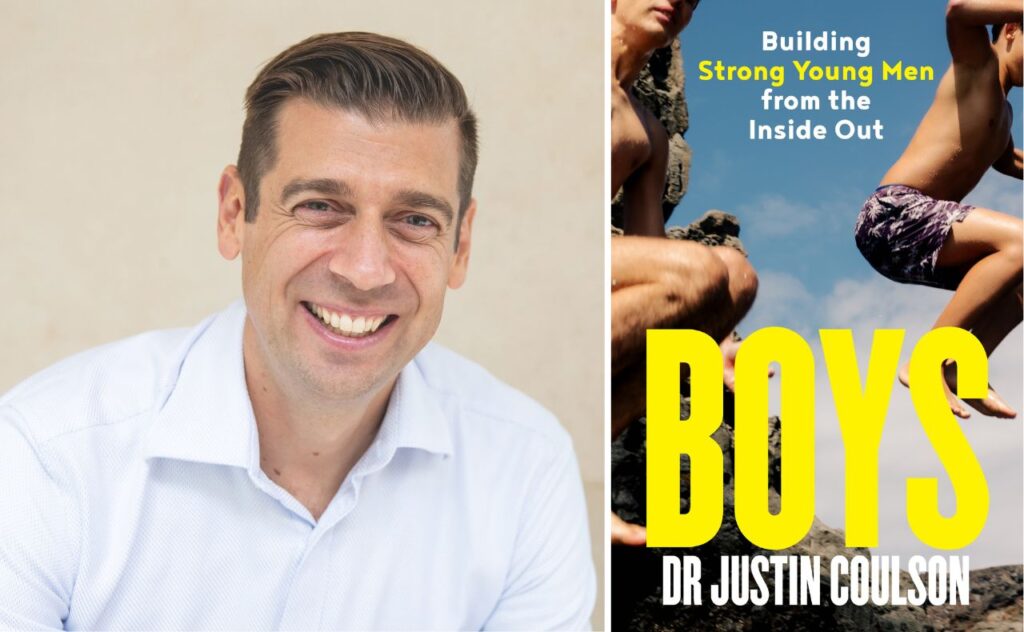
Dr Justin Coulson’s new book, Boys is available from June 16. (Image: Harper Collins Publishers Australia)